

Your Brain on Art
Art is a Cognitive Booster, Mood Enhancer, Career Developer, and Pain Manager.

Could browsing an art museum during your lunch break help your career development? Could listening to Mozart create new neural pathways? Can observing art or listening to music help boost your brain power and slow cognitive decline? Can engaging in creative activities lessen physical pain? And, if you’re feeling blue, could looking at something beautiful, listening to your favorite tune, or dancing to an uplifting melody alter your brain’s functioning to make you feel happier? Absolutely, and the research proves it. You don’t have to have special artistic abilities to make art or music. Art, music, and dance are equal-opportunity brain tonics with long-lasting impacts on physical, mental, and emotional health. I vote for increasing funding for all public and educational arts programs!
Despite the widely held belief that some people just aren't endowed with the creativity gene, there is no evidence that one person is inherently more creative than another, says psychologist Robert Epstein, PhD, author of The Big Book of Creativity Games (McGraw-Hill, 2000). It is not necessary to have natural artistic talent in order to benefit from making art and music. But, here are huge benefits to be gained.
The brain is plastic, referred to as neuroplasticity. Brain plasticity was mentioned for the first time over one hundred years ago. In 1840, Ramon y Cajal said that Every man can, if he so desires, become a sculptor of his own brain. Since then, scientists’ interest in brain plasticity has increased. Modern research has shown that the brain is capable of making new neural connections, activating new pathways, and unmasking secondary roads. The human brain is understandably adaptable during development. But, neuroplasticity shows that an adult brain also adapts as a response to new and persistent stimuli. (Kaas 1991, Johansson 2004). This is good news for anyone concerned about brain aging illness, have a family history of dementia, or have suffered brain injury.
To protect your brain, increase cognitive function, and pump up your creativity, you must use your brain in ways different from what you normally do. Epstein, as a visiting scholar at the University of California, conducted research showing that strengthening four core skill sets leads to an increase in novel ideas, and also stimulates improvements in brain health and functioning.
Epstein recommends that you:
Capture your new ideas. It doesn’t matter if you use a notebook, a cocktail napkin, a voice recorder, or your laptop — write new ideas down because this stimulates brain activity, creativity, and more new ideas.
Seek out challenging tasks. Generate new ideas by causing old ideas to compete through taking on tasks, or contemplating, ideas that don’t necessarily have a solution. Epstein’s humorous example was: trying to figure out how to make your dog fly.
Broaden your knowledge. Read or engage in the pursuit of knowledge that is beyond your typical scope. You could audit a class in an unfamiliar field of study, or read magazines or journals about topics you don’t know much about. You’ll do better in your life if you broaden your knowledge and stimulate new thinking. As you might imagine, researching topics for this blog gives my brain a workout.
Surround yourself with interesting things and people. Plan for regular dinners with a group of diverse and interesting friends. And festoon your workspace with art and out-of-the-ordinary objects to help you develop more original ideas. You may begin to think twice about the person a few cubicles away who has all that junk on their desk. You can also keep your thoughts lively by taking a trip to an art museum or attending the opera—anything outside your norm that stimulates new thinking.
If you think this is a waste of time, think again. A study last year published in the Creativity Research Journal (Vol. 20, No. 1), found that working on these four areas enhanced creativity and out-of-the-box thinking. The study included seventy-four city employees from Orange County, California. They participated in creativity training seminars consisting of games and exercises developed by Epstein to strengthen their proficiency in these four skill sets. Eight months later, the employees had increased their rate of new idea generation by 55 percent—a feat that led to more than $600,000 in new revenue and savings of about $3.5 million through innovative cost reductions.

Music and the Brain
The connection between music and brain functioning is not a modern idea. An ancient Chinese book, I Ching: The Book of Changes/Wisdom, that dates back to approximately 3000 BC contains a saying: “Music has the power to ease the tension within the heart and to lessen and loosen obscure emotions.” In the 6th century BC, Pythagoras found that the pleasant tunes he admired represented particular mathematical relations, which he recognized as harmony. He supported using harmonic music to achieve harmony in body functions. His followers prescribed specific tunes and dances as a cure for mood disorders (Karamanides 2006).
Music is a vibrant stimulus for neuroplasticity. fMRI studies have shown the reorganization of the motor and auditory cortex in professional musicians. Other studies showed the changes in neurotransmitter and hormone serum levels correlating with exposure to certain music. The most prominent connection between music and enhancement of performance, or changing of neuropsychological activity, was shown by studies involving the music of Mozart, resulting in what is known today as The Mozart Effect. Numerous studies have shown that listening to music can improve cognition, motor skills, and brain recovery after injury. It also reduces stress and related adverse effects on the body. All kinds of arts — music, painting, dancing stimulate the brain.
Art Therapy
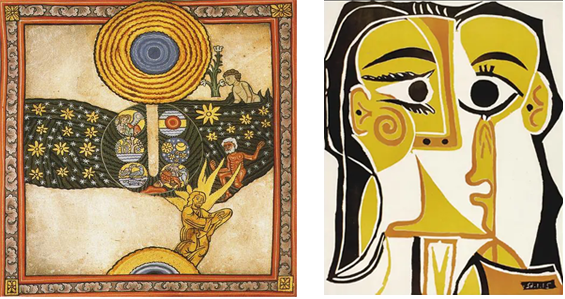
Art serves as a therapy that is effective in managing chronic pain conditions. Hildegard of Bingen, a German Benedictine abbess, suffered from migraines. She presented her visual migraine auras in her miniature paintings, shown below. Hildegard was a cultured woman of learning with diverse interests. She was a composer, philosopher, mystic, visionary, medical writer, health practitioner, and herbalist during the High Middle Ages. In her own “scientific” manner, she realized that her creative activities helped to reduce migraine pain. As an interesting side note, because of his pictures with splitting faces and specific perception of female faces, it was speculated that Pablo Picasso also suffered from migraines and was most likely an inspiration for his work.
As strange as it sounds, creativity can become an actual habit, says creativity researcher Jonathan Plucker, PhD, a psychology professor at Indiana University. He says that making it helps you become more productive. But, how does this occur?
Considered an expert in the neuroscience of aesthetics and creativity, Oshin Vartaniany completed a study exploring the diverse ways people observe and appreciate art using fMRI. This study found that in addition to the activation of the visual cortex when observing art, other, deeper state areas of the brain are also activated, such as the pleasure and reward (serotonin) system. A sort of daydreaming mode, which is beneficial and habit-forming, was activated during the conscious processing of images. The results showed that the brain processes and judges imagery even when the participants are not analyzing but only observing the artwork. This research helps prove that art has positive healing effects on the brain. The reverse is also true when people are exposed to ugly and violent images.
The conscious analysis of art also has benefits. Yale, Harvard, and the University of Texas Austin require medical students to visit museums and describe the works they view in precise detail. (Lesser, 2017) The activity improves observational skills to aid them in future diagnoses. Observing the changes that art invokes in students, medical schools started requiring physicians in training to take creative courses to boost their critical thinking skills. Penn State began a medical humanities program in 1967, and other universities followed suit. Professors found that performing arts, music, literature, and the visual arts build critical thinking, observation, communication, bias awareness, and empathy skills that “science” can’t provide.
Anyone focused on career-building, boosting cognitive function, or improve general health can benefit from the pursuit of creative activities. It may be wise to dust off your guitar case, spend more time at your piano, or create a dedicated space for visual arts and crafts. If you’re not the visual or musical type, then dance to your favorite music. You don’t have to be a professional artist or musician to reap untold rewards.
A well-known quote about the importance of art is, "Art washes away from the soul the dust of everyday life," attributed to Pablo Picasso, suggesting that art can cleanse and refresh our perspective on life by providing a space for deeper reflection and emotion. Evidently, it does much more than this!
If you like what I write about, please like or comment. This helps me to know your interests so that I can serve you better through Puck’s Traveling Medicine Show. Thanks for Reading!