


I recently came across a disturbing news story describing scientists using artificial intelligence to design viruses never seen before. Before this topic goes fully viral—if it hasn’t already—it’s worth stepping back from the headlines and examining what’s actually happening through a strategic lens.
For that, we turn to Sun Tzu.
“Know your enemy and know yourself; in a hundred battles, you will never be defeated.”
— Sun Tzu, The Art of War

In September 2025, researchers at Stanford University and the Arc Institute demonstrated something that would have sounded like science fiction not long ago: an AI system used to design entirely new viral genomes from scratch. Not modified versions of existing viruses, but novel genetic sequences that—when synthesized—successfully infected and killed bacteria in laboratory conditions.
This moment marks a threshold. AI has crossed from analyzing biological systems into actively generating them. That alone warrants attention—not panic, but clarity.
The Breakthrough: AI as a Designer of Life
The research team used a genome language model called Evo—often described as “ChatGPT for DNA”—to generate 302 new versions of a simple bacteriophage known as phiX174. This virus is among the most minimal known to science, containing just 11 genes and roughly 5,400 base pairs.
The AI-generated genomes were chemically synthesized and tested in living bacteria. Sixteen of them successfully replicated and destroyed their bacterial hosts. Some even outperformed the natural virus they were modeled on.
A few of these genomes were sufficiently distinct from any known virus that they would technically qualify as new species.
This is artificial evolution operating at machine speed.
The strategic question is not whether this matters, but how it does.
Sun Tzu’s Lens: Information, Not Alarm
“All warfare is based on deception.”
Sun Tzu understood that power lies not in spectacle, but in information—especially information about limitations. The real value of the Stanford research is not that AI can now “create viruses,” but that it reveals, quite clearly, where the boundaries of that capability currently lie.
A strategic mind looks past the headline and asks: What does this actually tell us about the terrain?
Knowing the Enemy:
What This Technology Can—and Cannot—Do
The breakthrough is real. But so are its current constraints.
Target simplicity: PhiX174 is one of the simplest viruses known. Designing organisms with greater complexity remains exponentially harder.
Low success rate: Only 16 of 302 AI-generated designs functioned—about a 5% success rate.
Host specificity: These viruses infected non-pathogenic E. coli under tightly controlled laboratory conditions.
Training limitations: The AI was deliberately trained without access to data on human-infecting viruses.
As synthetic biology pioneer J. Craig Venter has observed, this is essentially an accelerated form of trial and error. The AI is not “understanding” biology; it is pattern-matching at scale.
Even so, pattern-matching at scale matters. Which is why strategy—not fear—is required.
Identifying Vulnerabilities
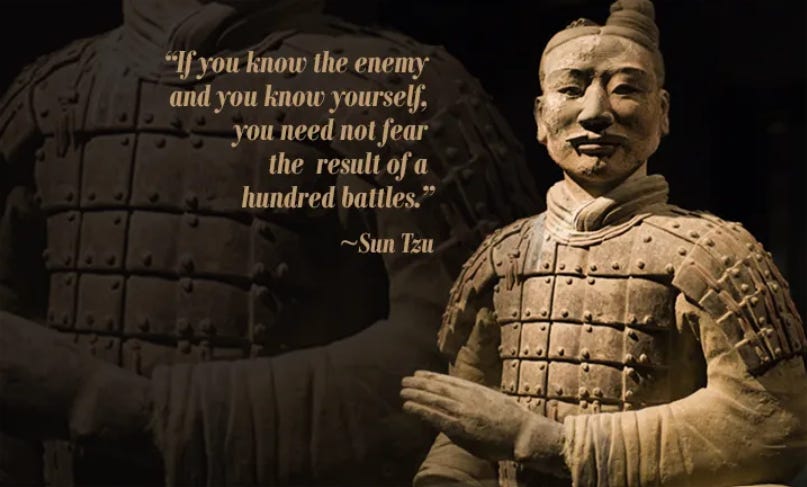
“If you know the enemy and know yourself, you need not fear the result of a hundred battles.”
Ironically, the research highlights several current vulnerabilities in AI-designed biological systems:
Complexity barriers: Scaling from a 5,400-base virus to even a simple bacterium involves combinatorial complexity beyond any current model.
Data dependence: AI cannot design what it has not been trained on. Remove key data domains, and whole categories of outcomes disappear.
Environmental fragility: Laboratory success does not translate cleanly into real-world conditions, where temperature, nutrition, microbial ecosystems, and immune responses vary enormously.
Functional uncertainty: High failure rates indicate deep gaps between genetic patterning and biological viability.
These are not trivial obstacles. They define the present limits of the battlefield. But, it doesn’t mean there isn’t a battlefield.
Knowing Yourself: Strategic Defense Without Escalation
“The supreme excellence consists of breaking the enemy’s resistance without fighting.”
This is where modern discussions often go astray. Strategic defense is not only the domain of governments, laboratories, or regulatory bodies. It also operates at the level of biological terrain.
This is not an argument against public health infrastructure or biosecurity oversight. Strategic defense always operates on multiple layers. The individual layer—often neglected—is simply one of them.
Biological Sovereignty as Strategy
A resilient biological system is difficult terrain. Many traditional medical systems recognized this long before modern immunology gave us its language.
Translated into contemporary terms, biological sovereignty means:
Metabolic robustness that supports immune signaling and cellular repair
Nutritional density that supplies the cofactors required for DNA maintenance and detoxification pathways
Healthy microbial ecosystems that resist opportunistic intrusion
Efficient liver, kidney, and lymphatic function that processes unfamiliar biological material
These are not exotic ideas. They are foundational physiology.
Importantly, systems designed for controlled laboratory environments tend to perform poorly in complex, adaptive, well-nourished biological terrain.
Practical Positioning (Not Panic)
Sun Tzu insisted that strategy must be actionable—but never noisy.
Strategic positioning today looks like:
Food sovereignty: Knowing where your food comes from and favoring systems that prioritize soil health and biodiversity.
Immune support: Adequate vitamin D, trace minerals, sleep, movement, and stress regulation—boring, effective, and cumulative.
Physiological clearance: Supporting liver, kidney, and lymphatic pathways through hydration, movement, and evidence-informed herbal support.
Reduced exposure: Simple measures like washing produce and minimizing unnecessary chemical inputs where possible.
None of this requires fear. All of it increases resilience.
The Larger Context
“In the midst of chaos, there is also opportunity.”
AI-assisted biological design will continue to advance. Some applications may be beneficial. Others will raise legitimate and serious concerns. History suggests that centralized, brittle systems invite asymmetric risks—while distributed, adaptable systems are harder to destabilize.
The same measures that improve resilience against speculative future threats also strengthen health against present-day stressors: infections, toxins, metabolic disease, and environmental strain.
This is not about rejecting technology. It is about not mistaking technological acceleration for strategic advantage.
Conclusion: Quiet Strength
The age of AI-designed life is not approaching—it has arrived. But this is not a moment for panic. It is a moment for literacy and voice.
Sun Tzu reminds us that the strongest position is one without obvious vulnerabilities. Strategic awareness does not require shouting about danger. It requires attention, understanding, and quiet preparation.
The future will not belong solely to those who design the most sophisticated systems—but to those who cultivate forms of resilience that are difficult to target, difficult to destabilize, and largely invisible.
“The ultimate in disposing one’s troops is to be without ascertainable shape.”
In biological terms: build terrain so robust that no synthetic intrusion easily takes hold.
That is strategic defense.
A like or share helps Puck and our stories find daylight again. The underworld is efficient, but not always kind.
This piece is part of a larger body of work. You can explore the topics and series here.
These 'interests are totally empowered because 2020 was obviously a success for these people. I just can't believe that individuals are still in the sick care/death care management system. This has been an emboldened moment for these interests that have made the people casualty of NKW aka non kinetic warfare.